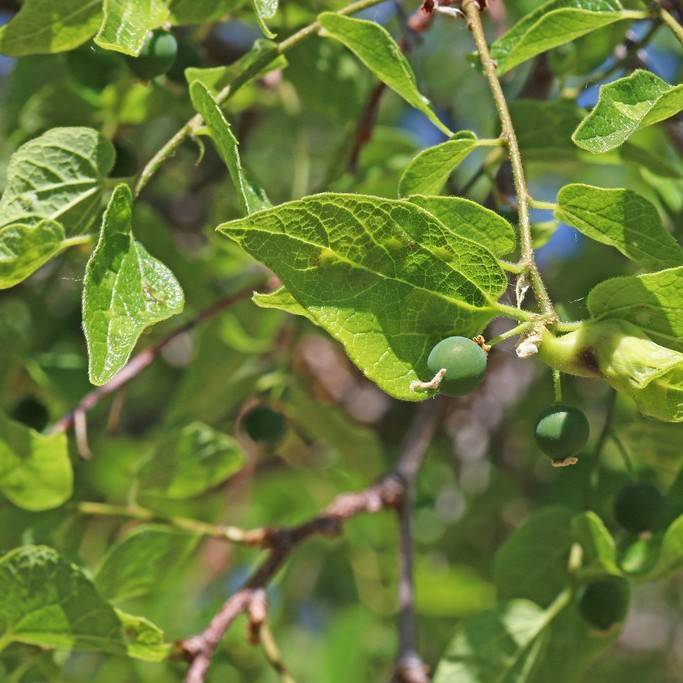
hackberry
Celtis occidentalis
Overview
Hackberry (Celtis occidentalis) is an amazing tree. It’s native to North America and grows in wet and poorly drained soils. It grows a wide network of strong, deep roots that make it wind tolerant and long-lasting, making it perfect for landscaping. It grows fast and can reach up to 20 meters tall with thick, heart-shaped leaves and long-lasting, creamy-yellow berries that give an autumn presence to your yard. Not to mention, it’s an excellent habitat for birds and wildlife, providing abundant food and shelter. Hackberry's resilience and hardiness make it an incredible addition to any yard or garden.
Care Guide
Watering
Hackberry (Celtis occidentalis) plants will respond positively to a regular watering schedule. During the early spring through mid-summer months when the plant is actively growing, water about twice a week. During hotter weather or periods of rapid growth, increase the frequency of watering. During fall and winter months, water less frequently, or only when the soil gets dry. Aim to keep the soil consistently moist but not overly wet. Avoid overwatering; soggy soil may cause the roots to rot. Ensure the soil drains well, and always empty the drainage saucer after every watering.
Light
Hackberry (Celtis occidentalis) is an adaptable plant species typically found in open areas with plenty of sunshine. Optimal growing conditions for a hackberry require at least 6 to 8 hours of direct sunlight each day for optimal growth and production of fruit. When the days begin to shorten towards the winter season, hackberry should still receive a minimum of 4 to 5 hours of direct sunlight each day. In areas with frequent cloud cover, it is best to supplement the sunlight with some form of artificial lighting.
Soil
Sandy Loamy Clay Rocky
Temperature
Hardiness zone 2-9.
Pruning
Hackberry trees should be pruned in late winter or early spring, when the tree is still dormant. The amount of pruning should be limited in order to maintain the natural shape of the tree. Dead, rubbing and crossing branches should be removed while cutting back the branches at a point where 2 branches meet. Branches that are too dense with foliage and do not permit circulation should be thinned out. Pruning should be kept to a minimum, and only the most necessary branches should be removed.
Propagation
Air Layering Propagation, Cutting, Grafting Propagation, Seed Propagation, Tissue Culture
Uses & Symbolism
Attracts: Birds, Butterflies.
Related plants
Other plants you might like if you grow hackberry.