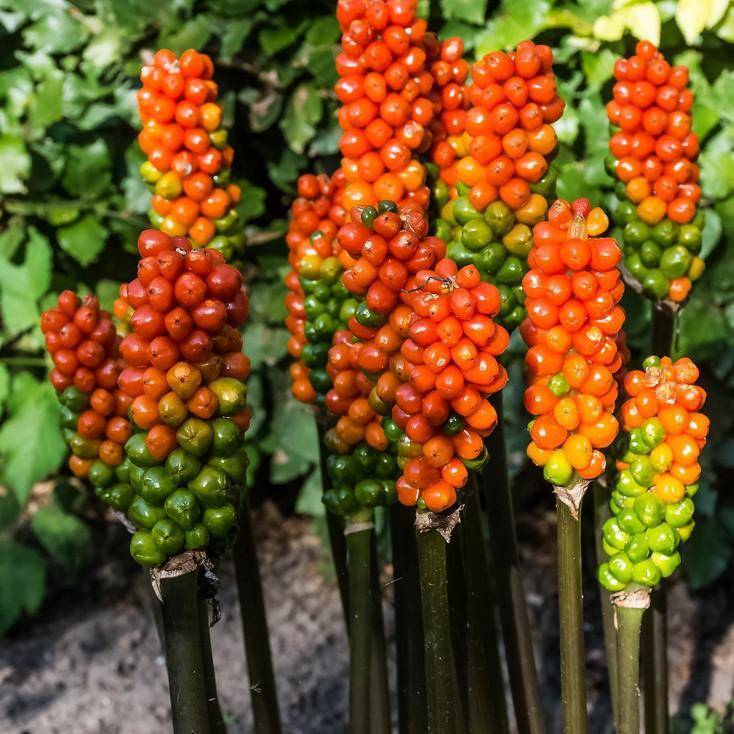
Italian arum
Arum italicum
Overview
Italian arum is an amazing plant species for many reasons. Firstly, its evergreen foliage and uniquely-shaped spathe are eye-catching features that will light up any garden. Secondly, Italian arum is extremely temperature-tolerant, making it an ideal choice for more temperate regions. Additionally, the plant only needs minimal maintenance and requires little water or soil enrichment during its life cycle. Finally, its long-blooming and sometimes fragrant flowers produce berries that birds and other wildlife are sure to enjoy. It truly is a must-have for any garden.
Care Guide
Watering
Italian arum plants should be watered about once every 7 to 10 days, depending on your local climate and soil conditions. Water the plants at the base, making sure to avoid getting the leaves wet. It's best to water the plants in the morning to give them time to dry out before nightfall. During the summer months, it may be necessary to water them more frequently than in the cooler winter months. Make sure the soil is moist, but not waterlogged. If the soil is sandy, you may need to water more often than if the soil is more loamy. A good rule of thumb is to make sure the top 2 to 3 inches of soil are moist. Avoid over-watering, as this can detrimentally affect the plant's health.
Light
Italian arum (Arum italicum) prefers full sun for at least 4 hours a day, particularly in the mornings. During the spring and summer months, the plant should receive around 6 to 8 hours of sunlight a day. However, it is important to make sure that the plant is not receiving too much direct sunlight. During the cooler months, aim for around 4 to 6 hours of sunlight each day.
Temperature
Hardiness zone 5-9.
Pruning
For Italian arum, pruning typically happens in the late spring or early summer during the period of active growth. Pruning should involve removing dead foliage, as well as any out-of-place, overgrown, or otherwise unwanted foliage. You should also trim long branches and remove any crossed, overlapping, or damaged branches. Prune the plant lightly and sparingly- no more than 1-third of the overall foliage and stems. This will help promote new, healthy growth, as well as providing the plant with more air and sunlight.
Propagation
Division, Cormlet Propagation, Seed Propagation, Cutting
Related plants
Other plants you might like if you grow Italian arum.