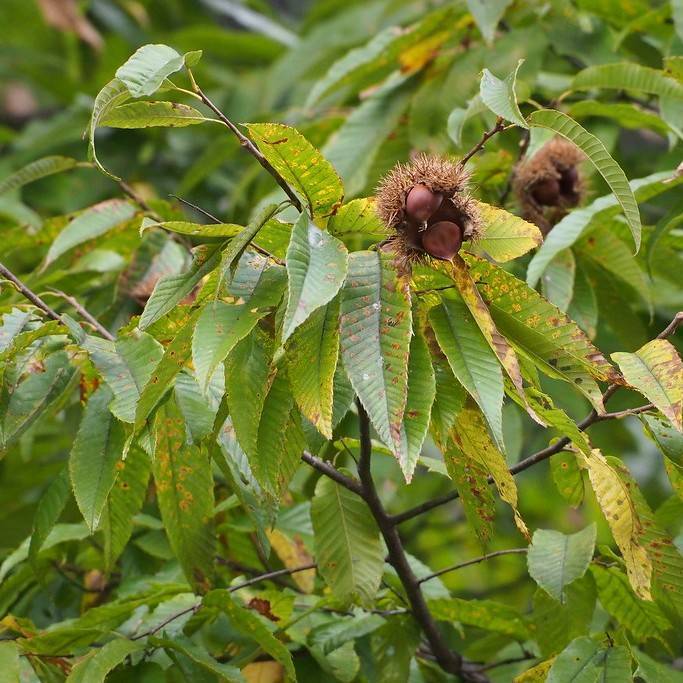
Japanese chestnut
Castanea crenata
Overview
The Japanese chestnut (Castanea crenata) is a truly amazing plant species. It is native to East Asia and is fast growing and highly productive. The tree bears large, sweet chestnuts and is highly resistant to a range of diseases and pests. Its growth habit is asymmetrical with dark green foliage that turns red in autumn, making it a highly attractive addition to any landscape. Japanese chestnuts can tolerate sun or light shade and are drought tolerant, making them suitable for a wide range of climates. They are also early bearing, with good fat content, flavor, and a high-yield potential. Overall, the Japanese chestnut is a great choice for anyone who wants a beautiful and productive plant in their landscape.
Care Guide
Watering
Japanese chestnut (Castanea crenata) prefers moist, well-draining soils and requires approximately 1-2 inches of water per week from either rain or manual irrigation. Water the chestnut slowly and deeply to ensure that it soaks up enough water to reach its roots. Monitor your chestnut’s moisture levels during periods of drought or extreme heat. If the soil feels dry, water the root zone deeply to ensure that your chestnut has access to a consistent supply of water.
Light
Japanese chestnut (Castanea crenata) prefers to receive direct sunlight for 3 to 4 hours per day. Ideally, the plant should be placed in a spot that receives morning sun and then shade or dappled sunlight during the afternoon hours. Too much direct sunlight in the afternoon can cause the leaves of the Japanese chestnut to burn.
Temperature
Hardiness zone 4-8.
Pruning
Japanese chestnut (Castanea crenata) is best pruned during the late winter, ideally in late February to early March. Pruning should involve removing all dead, diseased, or damaged branches. Branches that are growing in an undesirable direction should also be removed. Light pruning can also be done in late summer, focusing on any straggly and crossed branches or shoots. Heavy pruning should be avoided as Japanese chestnut is a slow-growing tree. Limit pruning to removal of dead, diseased, and damaged wood and light shaping.
Propagation
Grafting Propagation, Cutting, Air Layering Propagation, Seed Propagation
Related plants
Other plants you might like if you grow Japanese chestnut.







