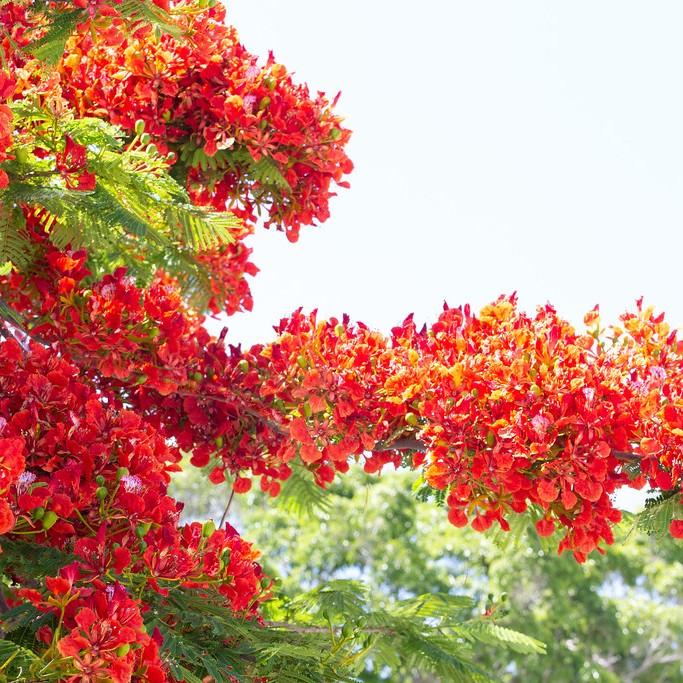
royal poinciana
Delonix regia
Overview
The Royal Poinciana (Delonix regia) is an amazing tree species. It has a majestic presence, with a graceful spreading canopy providing dappled shade. Its large, rounded and fern-like foliage is accompanied by a procession of eye-catching, plume-like clusters of bright-orange flowers, which are held from spring to autumn. The Royal Poinciana is an ideal plant for creating a striking feature in any garden or courtyard. It provides beauty during the summer and visual interest in the winter with its long seed pods. The Royal Poinciana is also drought-tolerant and responds well to pruning. Its versatility and beauty make it a wonderful addition to any landscape.
Care Guide
Watering
The Royal Poinciana (Delonix regia) should be watered regularly, but avoid overwatering. It is best to water the plant no more than twice a week during a period of active growth (the warm, summer season). During the cold, winter months, you can reduce watering to once a month. When watering, drench the soil completely until water begins to run off, then allow the soil to dry out before watering again. Avoid leaving the soil soggy for extended periods of time.
Light
Royal poinciana (Delonix regia) is a tropical species that requires plenty of sunlight. Ideally, the plant should receive at least 6-7 hours of sunlight daily, but does best with 8-10 hours of direct sunlight. The royal poinciana should be grown in full sun, meaning that the plant should be planted in a location that receives direct and unobstructed sunlight for most of the day. During the summer months when the days are longer, royal poinciana plants may be happy with as much as 12 hours of daily sunlight. Sunlight is important for the plant's health, as it helps the plant to create the food it needs to survive.
Temperature
Hardiness zone 10-12.
Pruning
The Royal Poinciana (Delonix regia) is a lush and fast-growing tree that generally requires minimal pruning. If pruning is necessary, it should be done during the tree's dormant season in the late winter or early spring before any new growth begins. Prune away any damaged or dead limbs, and then selectively trim away any overhanging branches or crossing branches to keep the tree's shape attractive. Do not prune more than 1/3 of the total foliage mass at any 1 time.
Propagation
Air Layering Propagation, Grafting Propagation, Cutting, Seed Propagation
Related plants
Other plants you might like if you grow royal poinciana.







