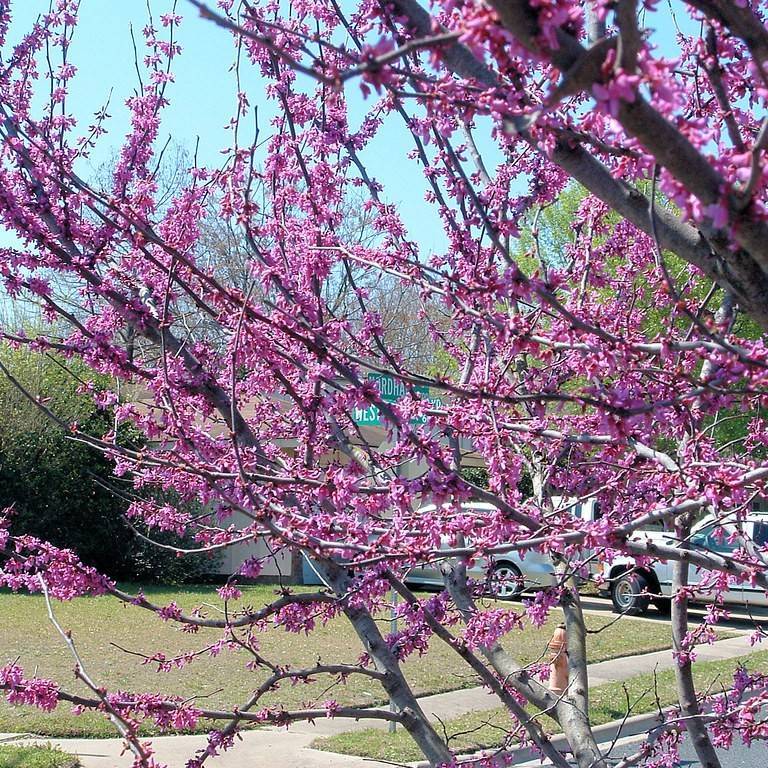
Texas redbud
Cercis canadensis var. texensis
Overview
The Texas Redbud is a beautiful plant species native to the Lone Star State. It is a deciduous shrub or small tree with a dense spreading crown, and features gorgeous heart-shaped leaves. Its vibrant rosy-pink flowers come in clusters, appearing in early spring before the foliage unfolds. This dazzling beauty also provides plenty of wildlife benefits: birds and pollinators are attracted to the foliage and nectar-rich flowers, and its edible bean-like pods provide a great source of food for small animals. Its tolerance for a range of soil types and drought conditions makes the Texas Redbud an easy to care for and appealing addition to any garden.
Care Guide
Watering
Watering for Texas redbud (Cercis canadensis var. texensis) should be done regularly to keep the soil slightly moist. In the warmer months, watering should be done 1 to 2 times a week, providing 1 inch of water each time. In the cooler months, watering should be done less frequently, roughly every 2 to 3 weeks, providing 1 inch of water each time. Make sure to water mainly the root area of the plant, as wet foliage can lead to diseases. It's also a good idea to check the soil every few days to see if the plant needs any extra water.
Light
Texas redbud (Cercis canadensis var. texensis) thrives in full sun to partial shade. When providing sun for Texas redbud, it should ideally receive 6-8 hours of direct sunlight per day. During hot summer months, it may benefit from some light shade or morning sun followed by afternoon shade. Too much sun exposure can lead to leaf scorch.
Soil
Humus rich, Well-drained
Temperature
Hardiness zone 5-5.
Pruning
Texas redbud should generally be lightly pruned in late-spring after flowering has finished. It is best to do selective pruning of limbs or stems, which are crossing or rubbing against each other, or that are out of place in the desired shape, to maintain a natural shape and to achieve an open structure. A light pruning every 2 to 3 years should be adequate. Texas redbud is a slow growing plant and its attractive form should not require shearing or trimming.
Propagation
Seed Propagation, Grafting Propagation
Uses & Symbolism
Attracts: Butterflies.
Diseases & Pests
Common pests: Canker, sap rot, Scale insects, Wilt.
Related plants
Other plants you might like if you grow Texas redbud.